

How We Change Lives
How We Achieve Better Outcomes for Children and FamiliesWhat We Invest
StaffVolunteers
Training
Partnerships
Resources
ENHANCE PARENTING CAPACITY AND WELLBEING
Parents/Caregivers increase their coping and parenting skillsParents/Caregivers receive support for their mental and physical health, and their holistic well-beingParents/Caregivers understand and promote their child’s development in all domainsSTRENGTHEN FAMILY RESILIENCE, RESOURCES, AND RELATIONSHIPS
Families experience opportunities to enhance their resilience and strengthen their relationshipsFamilies have hope for their futureFamilies access community support services and resources to meet their unique needsPROMOTE CHILD DEVELOPMENT AND WELLBEING
Children have enrichment opportunities at the Children’s Cottage and/or in their family home Children have access to health/well-being resources and are referred to culturally informed preventative & supportive resourcesChildren receive support to achieve their developmental capacityBUFFER CHILDREN FROM ADVERSE EXPERIENCES AND TOXIC STRESS
Children are sheltered from exposure to family crisis and instabilityChildren receive protection from child maltreatment and harmChildren receive protection from the impact of poverty and deprivationWhat we track…
Parents and children servedPrograms accessedScreenings completedAssessments & outcome measures completedReferrals providedThe Brain Story: An evidence-based approach
Applying the Brain Story
The Brain Story tells us that ongoing negative experiences, especially in the earliest years, increase a person’s risk of developing a number of health issues later in life, from addiction and other mental illnesses to heart disease, diabetes, and even cancer.
It also gives us a clear understanding of which interventions are the most effective at improving outcomes, and when and how to apply them.
By supporting healthy brain development in infancy and childhood, we create a solid foundation for lifelong mental and physical health.
Building Resilience
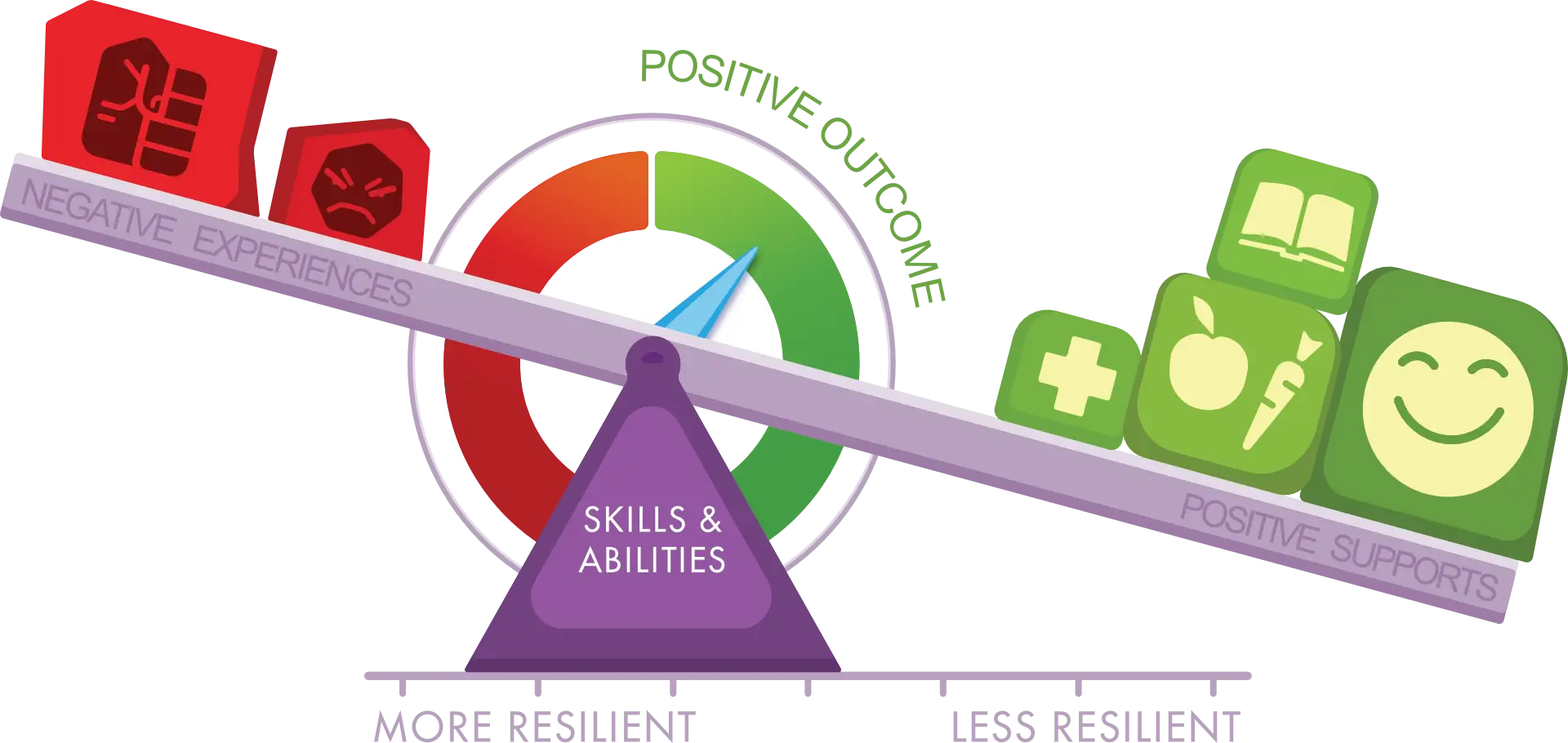
Resilience is a person’s ability to maintain a state of well-being even when facing severe adversity. It describes our capacity to manage stress, function well when experiencing hardship and return to a state of good health. Developing resilience starts when we’re infants and continues through young adulthood. It’s possible to develop resilience throughout our lives, but the early years are the most significant.
Picture resilience as a scale with protective factors (like responsive caregivers and supportive communities) stacked on one side. These are represented by green boxes in the illustration. Risk factors like abuse, neglect and parental addiction, represented by red boxes, are stacked on the other. If the risk factors outweigh the protective factors, the scale will tip in a negative direction,
resulting in negative outcomes.
The reverse is also true, resulting in positive outcomes. The base (or fulcrum) of the scale represents traits that we’re born with or that we develop over time in the form of skills and abilities. If it’s set closer to one end or the other, it becomes easier or more challenging to tip the scale in a positive direction. With enough positive supports, it’s possible to build skills and abilities, moving the fulcrum in a direction that favours positive outcomes.
By preventing the red boxes of adversity from piling up while adding the green boxes of protective factors, we can help children develop greater resilience over time.